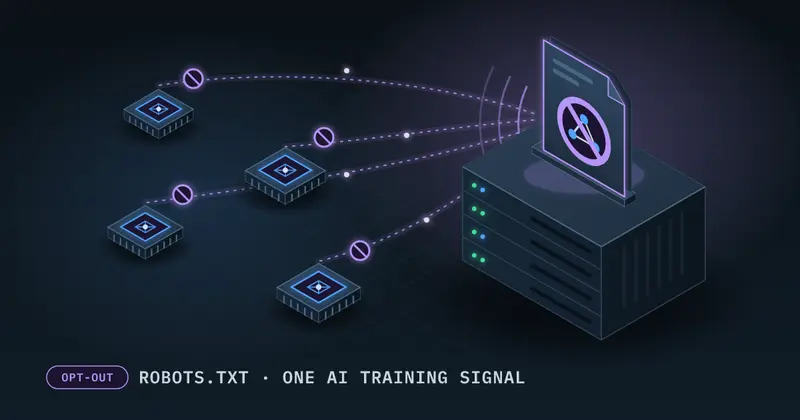
On 30 October 2026, Google, Microsoft, OpenAI and Anthropic announced that they will honour one shared signal in robots.txt for AI training preferences. Today a site that wants to opt out has to list each AI crawler separately; the shared policy token lets it state one preference to every participating provider. It comes from an individual IETF draft, draft-kelley-aipref-training-preference-signal-00, written by Anthropic's Kevin Kelley and discussed in the IETF AI Preferences (AIPREF) working group. PPC Land notes the draft has no formal IETF standing yet.
How it looks. The token is used in place of a crawler name:User-Agent: __usage_ai-trainingDisallow: /
A path can be excluded instead of the whole site, and Allow lines can carve out exceptions. According to the draft, as reported by PPC Land, rules under User-Agent: * do not count as a training preference, and the token governs how content is used, not whether it is crawled.
When each company starts. Microsoft will honour AI Training and a new AI Grounding preference as it crawls from 1 February 2027. Google says it aims to support the control "along with other AI providers in 2027"; if a site opts out through the token and says nothing about Google-Extended, Google will treat it as a Google-Extended disallow. According to PPC Land, OpenAI calls it a "voluntary effort" to roll out "in the coming months", and Anthropic says implementation has started; neither gave a date. Existing per-crawler rules keep working.
Microsoft goes further. Bing adds page-level controls via meta tag or X-Robots-Tag header (for example <meta name="Bingbot" content="ai-training:disallow">) and a separate AI Grounding preference — whether pages may feed AI-generated answers — with Allow, Disallow or DisallowExtended (Microsoft's own products only). From 1 March 2027, NoArchive and NoCache will no longer be read as training or grounding preferences. Microsoft says none of this changes eligibility for Bing search results.
Limits. The signal is voluntary with no enforcement; the draft says providers "MAY" skip opted-out content, and private licensing deals can override it. It does not cover content collected earlier. Meta, Amazon and Apple are not among the companies that committed, PPC Land notes.