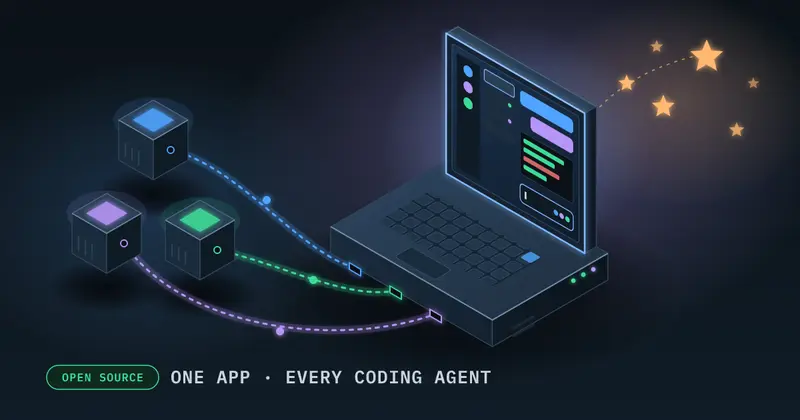
T3 Code, an open-source app from Theo Browne's T3 team (repository pingdotgg/t3code), gained about 12,500 GitHub stars in a week and now has more than 45,000. It is not a model and not a hosted coding agent. It is a single interface for the agents already on your machine. The README calls it an "agent harness control surface" and lists Codex, Claude (Claude Code), Cursor, Grok Build, OpenCode, Google Antigravity and fx. Each provider has to be installed and logged in first (for example codex login or claude auth login).
The project is free and MIT-licensed and works with your existing subscriptions; asked what it sells, the README says "Nothing". It runs as an Electron desktop app, a web app (npx t3@latest tries it without installing) and iOS and Android apps. Flavio Copes describes the design in his deep dive: a T3 Code server owns the files, Git, terminals and credentials, and the clients only show the work. Remote access goes through the managed T3 Connect tunnel, Tailscale or SSH.
Version 0.1.7, tagged on 4 November 2026, adds Kiro as an early-access beta provider, managed policies for central administration (including Windows Group Policy), one-time schedules and shareable thread links. The release notes count 659 changes from 160 contributors. Copes lists the features: four permission modes from Supervised to Full access, Git worktrees, per-turn diffs with checkpoints, built-in terminals, and pull-request handling for GitHub, GitLab, Bitbucket and Azure DevOps.
The maintainers warn: "We are very very early in this project. Expect bugs." They are also "(mostly) not accepting contributions yet". Copes adds some limits. Prompts still go to the chosen provider, because only the agents run locally. Switching providers mid-thread is "lossy". Full access gives the agent full access to the server machine, and checkpoints are not backups.